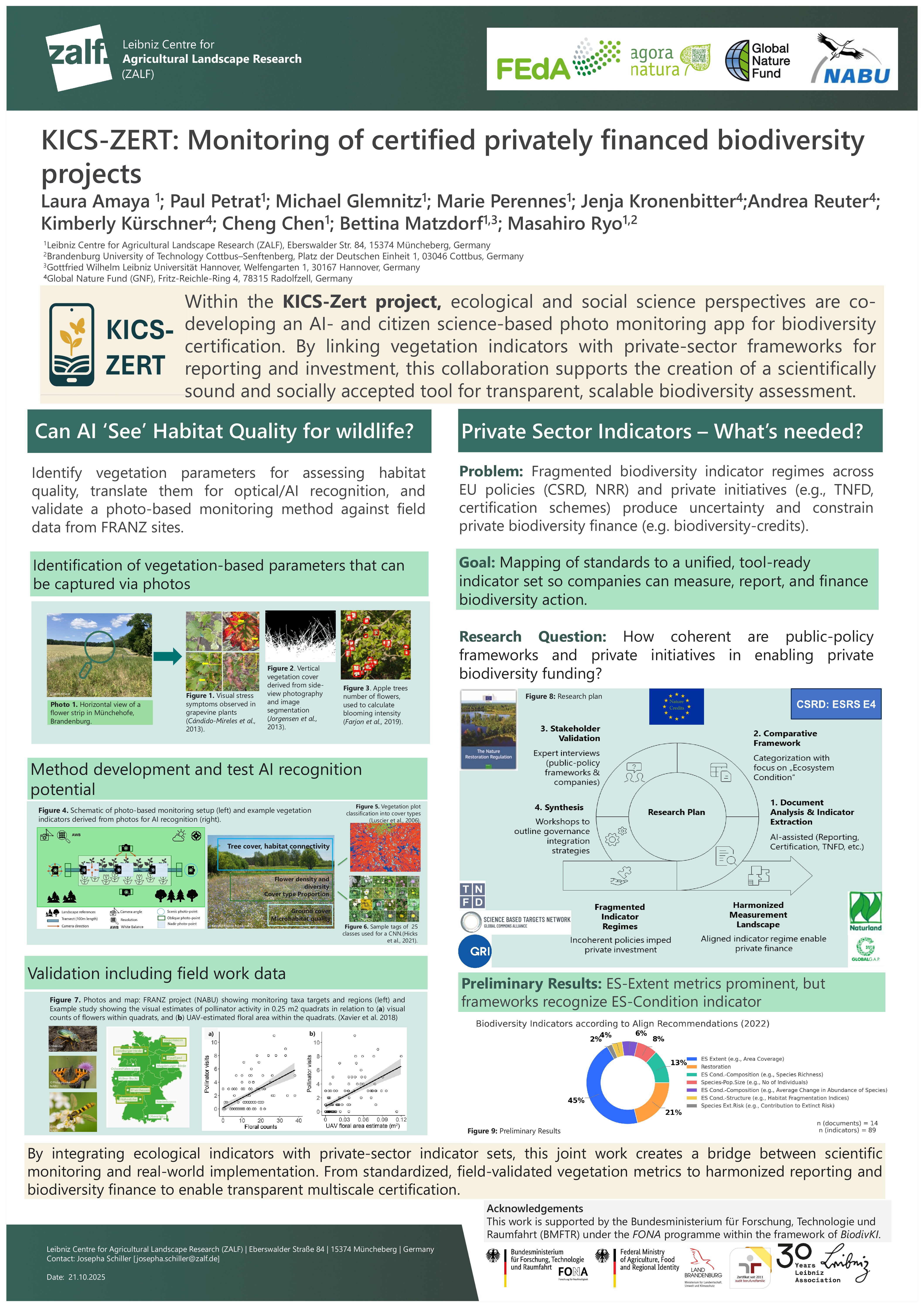
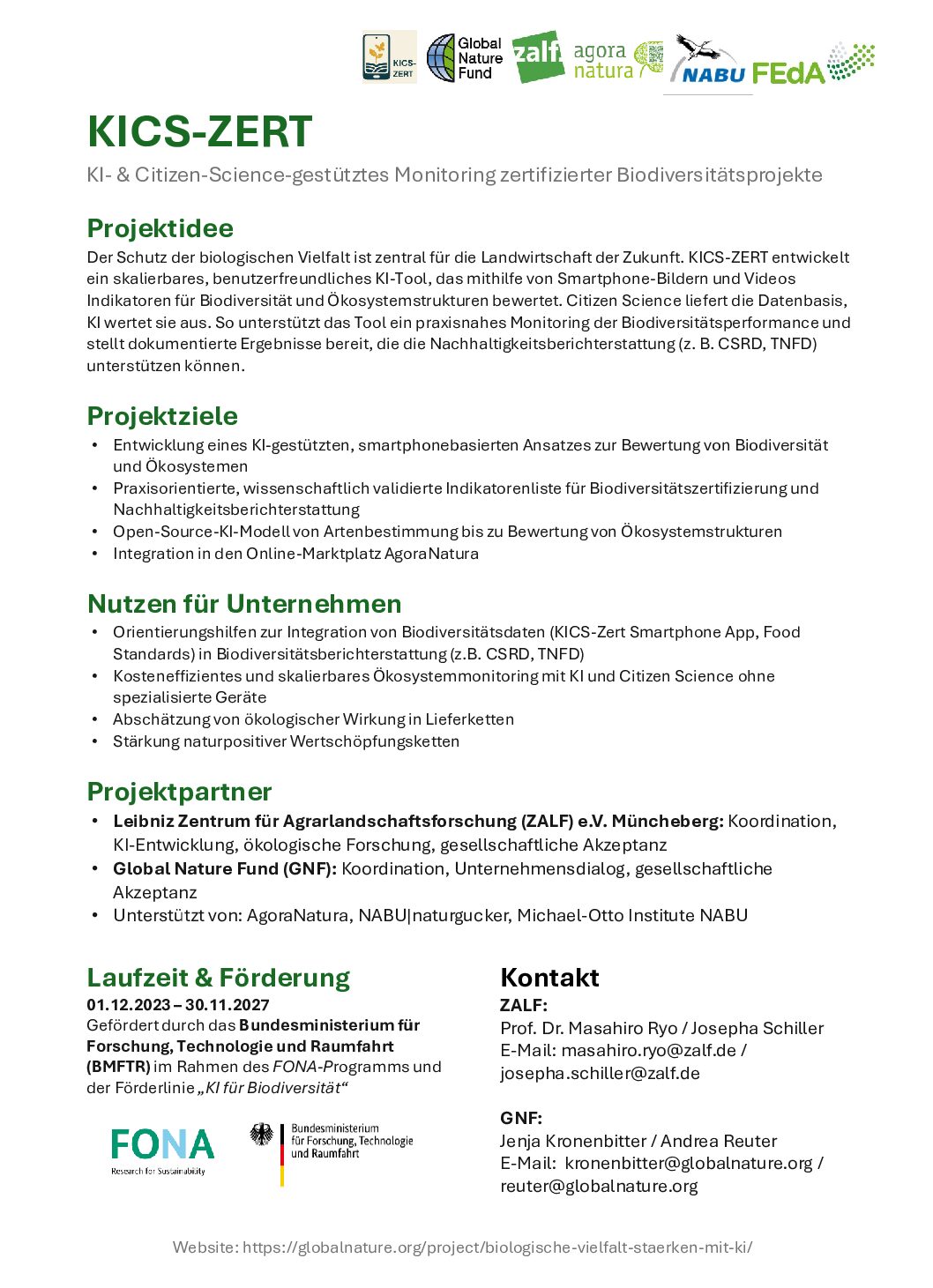
We want economic actors and citizens to be more involved in the protection of biodiversity. To facilitate this, we are working on the development of an AI-supported monitoring tool. This will simplify and improve the assessment of biodiversity and the certification of areas for biodiversity conservation.

Until now, experts have been assessing and evaluating the state of biodiversity on agricultural land. In our project “AI and Citizen Science-Based Monitoring of Certified Biodiversity Projects” – KICS-Zert for short – we are working with the Leibniz Centre for Agricultural Landscape Research (ZALF) on a new tool that improves or replaces biodiversity monitoring using AI through citizens (Citizen Science). It evaluates smartphone photos and videos to determine how diverse nature is in a location (e.g. orchards, hedges and flowering areas) and how heavily the agricultural areas are used there.
The GNF is responsible for ensuring that the needs of companies are taken into account during the development of the project. This includes an analysis of current reporting and management standards as well as relevant food certifications. In this way, we support companies with the new tool in meeting their sustainability and certification requirements. The AI is fed with data from nature observation apps used by citizens throughout Germany.
Project area
Goals

Development of a cost-effective, scalable, user-friendly AI tool that assesses the state of biodiversity and ecosystem structure in agroecosystems

Gaining trust and social acceptance for the use of AI to consistently protect biodiversity and ecosystems
Impacts

Networking computer science and biodiversity

Support for monitoring through AI

Citizen participation/Citizen Science
Impressions


Contribution to the sustainability goals



Latest news
Research Publications
Cropping history, agronomic rules, and commodity prices shape crop rotations across Central Europe
Palka, M.; Nendel, C.; Weiß, L.; Schiller, J.; Jänicke, C.; Arbeláez Gaviria, J.; Ryo, M. (2026)
Agricultural Systems, 231, 104522
Journal Articles
The study analyzes more than 16 million field-year data sets from Germany, Austria, and the Czech Republic. Machine learning is used to examine how cropping history, agronomic rules and commodity prices influence crop rotations. Projections through 2070 indicate an increase in legume cultivation. The results are intended to improve agricultural models and the assessment of future cropping patterns.
AI for a Planet Under Pressure
Galaz, V., et al. (2025)
Stockholm Resilience Center / Potsdam Institute for Climate Impact Research
Report / Preprint
The report examines how AI can contribute to research on complex sustainability issues and where its limitations lie. Eight thematic areas range from climate risks and Earth systems to oceans, freshwater, and biodiversity, as well as cities, science communication, and collaborative decision-making. The authors emphasize that AI must be used responsibly so that it does not exacerbate inequalities and environmental impacts.
Artificial intelligence in environmental and Earth system sciences: explainability and trustworthiness
Schiller, J.; Stiller, S.; Ryo, M. (2025)
Artificial Intelligence Review, 58, 316
Journal Article · Open Access
This review examines 575 studies on explainable AI in environmental and Earth system sciences. It shows in which fields and using which methods complex models can be made understandable. Only a few of the studies examined treat trustworthiness as a central research goal. The study therefore recommends a people-centered approach that takes into account the various stakeholders and their needs for reliable decisions.
AgriBench: A Hierarchical Agriculture Benchmark for Multimodal Large Language Models
Zhou, Y.; Ryo, M. (2025)
Computer Vision – ECCV 2024 Workshops, LNCS 15625, 207–223
Conference paper / Book chapter
AgriBench is a benchmark for evaluating multimodal large language models for agricultural applications. In addition, the authors introduce MM-LUCAS: a dataset containing 1,784 landscape images, segmentation masks, depth maps, and detailed information on land cover and land use. The data is based on the European LUCAS survey. This article describes an approach for systematically evaluating the domain-specific capabilities of such models.
Read the article on Springer
Preview freely available; access to the full text may be required.
Selected from the FEdA literature portal. The links lead to external original sources.
Project Video
You are currently viewing a placeholder content from YouTube. To access the actual content, click the button below. Please note that doing so will share data with third-party providers.
More InformationContact persons





Prof. Dr. Masahiro Ryo
Head of the working group "Artificial Intelligence for Digital Agriculture"
Leibniz Center for Agricultural Landscape Research (ZALF) e. V. Müncheberg
E-mail: masahiro.ryo@zalf.de
Dr. Josepha Schiller
Project Coordination & Research
Leibniz Center for Agricultural Landscape Research (ZALF) e. V. Müncheberg
E-mail: josepha.schiller@zalf.de