

Whether it is invasive species, land use, overexploitation of natural resources or pollution – many companies have never systematically assessed their impact on biodiversity, or only in a rudimentary way. Even fewer companies are aware of the services provided by nature – the “ecosystem services” – on which their business model actually depends. The biodiversity check shows how this can be done.
Gaining an overview and quickly implementing measures to protect biodiversity: This is the aim of the Biodiversity Check, which the Global Nature Fund (GNF) and the Lake Constance Foundation have been offering companies for over ten years. In the “Unternehmen Biologische Vielfalt” project, the two NGOs have further developed the check and, together with the CSCP Think & Do Tank, adapted it specifically for four sectors: (1) the food industry, (2) DIY stores, (3) the clothing, fashion and textile industry and (4) the chemical industry. Here we report on GNF’s experiences and findings from its cooperation with DIY and home improvement stores. This is of considerable relevance in Germany: 68 percent of Germans are involved in home improvement projects, and the DIY trade in Germany generated a total turnover of 21.24 billion euros in 2023.
Heide Schulte-Beckhausen, Head of ESG at OBI Group Holding, summarizes why OBI participated in the assessment: “We were particularly interested in the analyses of biodiversity in the value chain and in the product portfolio, as we see this as the area where OBI has the greatest potential for impact.” Kai Battenberg, Lead Sustainability and Product Compliance at toom Baumarkt, concludes: “The protection and promotion of biodiversity has been the focus of toom Baumarkt’s commitment to sustainability for many years. In the biodiversity check, the topic was once again examined comprehensively and in a sector-specific manner.”
Relevance of biodiversity for companies in the DIY sector
Biodiversity is often described as the basis of life and the economy. This becomes quite obvious when you look at the food industry. Their production is based on healthy soils, water cycles and pollination by a variety of insects. However, the relevance of genetic diversity, species diversity and ecosystem diversity also becomes clear in a less intuitive industry example such as DIY stores. This industry is particularly dependent on non-renewable raw materials such as metals, minerals, sand and stone, which are required for the production of building materials. At the same time, renewable raw materials such as wood, natural fibers, substrates and ornamental plants play an important role in the product range. DIY companies are dependent on intact biodiversity and stable supply chains in order to be able to satisfy the growing demand from customers for high-quality natural product solutions in optimum quality, quantity and variety.
The industry is also dependent on the provision of ecosystem services. These include
- the quality and quantity of water for most production processes,
- the genetic variability of plants to ensure healthy production of wood, natural fibers and plants,
- the provision of abiotic raw materials (stones, sand, crude oil, etc.),
- the provision of natural raw materials and fibers, e.g. wood and cellulose for packaging, and
- Maintaining a stable environment for production in order to avoid supply interruptions, e.g. due to extreme weather conditions/water shortages.
Recognizing these dependencies and identifying corresponding risks in procurement and production processes is one aspect of the materiality assessment that will affect many companies in the EU from 2025 as part of the new sustainability reporting requirements (CSRD).
 © GNF
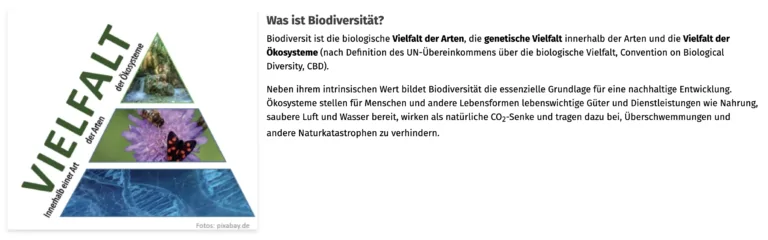
© GNFFigure 1: What is biodiversity?
Recognizing these dependencies and identifying corresponding risks in procurement and production processes is one aspect of the materiality assessment that will affect many companies in the EU from 2025 as part of the new sustainability reporting requirements (CSRD).
The other side concerns the impact of companies on the state of biodiversity. The causes of biodiversity loss are manifold. This includes
- the overexploitation of natural resources,
- Environmental pollution,
- the impairment of habitats,
- the introduction of invasive alien species and
- climate change.
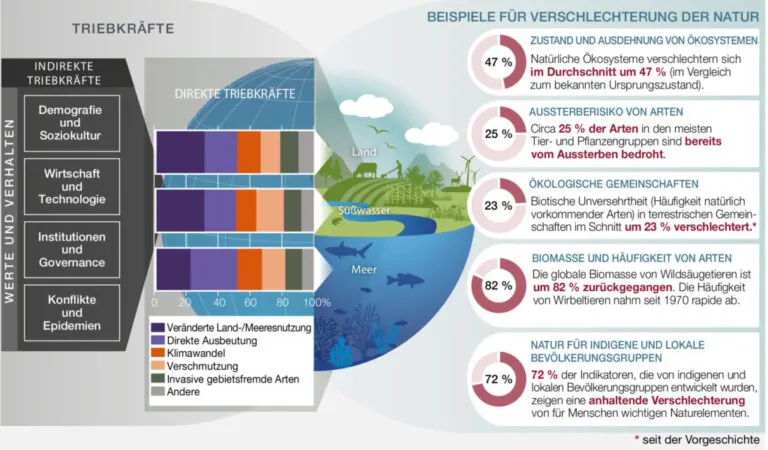
The following figure shows how various direct factors influence changes in terrestrial ecosystems, freshwater resources and oceans and illustrates the extent with selected examples. This shows that all ecosystems are affected by direct influencing factors. In particular, changes in the use of land and oceans (dark purple) and the direct exploitation of natural resources (light purple) are responsible for more than 50 percent of the global impact on ecosystems. (Cf. Helmholtz Centre for Environmental Research, The “Global Assessment” of the World Biodiversity Council IPBES – Excerpts from the “Summary for policymakers”, 2019, p. 6, https://fmos.link/29345. The illustration is also taken from the report. The English original is available here.
 © IPBES
If we look at the DIY sector, there are also direct and indirect effects on biodiversity, both at our own sites and in the upstream and downstream supply chains. With over 60,000 articles, it is difficult to draw up and quantify an overall balance. The biodiversity sector check has shown that the DIY sector has a particularly high impact along the supply chains in the building materials, wood and ornamental plants product ranges. But other areas, such as metals or plastics, must also be given greater consideration in the industry’s sustainability management.
Due to the high number of stores and often even the close proximity to nature conservation areas, it is advisable for the sector to focus more on the ecological upgrading of parking lots and facades at its own locations, where feasible. There is also potential for improvement in the areas of logistics and light pollution.
Methodology
The Biodiversity Check is an instrument that GNF developed together with the Lake Constance Foundation for the European Business and Biodiversity Campaign in 2010. The check provides an initial overview of the relationship between companies and biodiversity in terms of opportunities, impacts and risks.
The check does not replace a biodiversity impact assessment, but provides arguments for the design of a company’s biodiversity strategy. Based on the procedures of the EMAS and ISO 14001 environmental management systems, possible negative effects of individual business areas, production facilities, products or processes on biodiversity are analyzed. The check enables the company to identify potential risks and opportunities in relation to biodiversity.
The check is confidential so that problems and potential obstacles can be discussed openly. During the check, the company’s direct impact on biodiversity, for which the company is clearly responsible and which it can influence, is examined. The check also takes into account the indirect effects that the company can influence through dialog with its stakeholders.
Areas of analysis include
- Strategy and management
- Company premises, real estate
- Procurement: raw materials, water, suppliers, certifications, etc.
- Product design and development
- Logistics and transportation (including invasive )
- End products and utilization
- Communication and marketing
- Human resources
Implementation of the biodiversity check
The biodiversity check procedure at company level generally consists of five steps (Figure 2). It is particularly relevant that, in addition to analyzing the various processes in the company, the exchange with the relevant stakeholders is also a central component.
A roundtable discussion involving representatives from all departments—and, ideally, senior management—should help the sustainability department gain support for Business Biodiversity and implement effective measures. This often only works if those responsible provide mandates and budgets. The results of the check and the proposed measures are discussed at the round table. The aim is to come out of the meeting with concrete steps for prompt implementation.
 © GNF
© GNFFigure 2: Process steps of the Biodiversity Check
Industry check
With the support of the German Home Improvement, Building and Garden Trade Association (BHB) and four companies in the DIY sector – BAUHAUS, Globus, OBI and toom Baumarkt – the GNF has also developed an “Industry Biodiversity Check” for DIY companies as part of the “Unternehmen Biologische Vielfalt” project.
It is based on a comprehensive screening of the entire DIY sector, the experience of stakeholders in the field of biodiversity and sustainability management and the implementation of biodiversity checks with the four companies mentioned, which have contributed their knowledge to this process.
This guide is aimed at companies in the DIY sector, including garden centers and specialist retailers.
Linking with reporting and international methods
While biodiversity was a “voluntary” issue for a long time, the EU has established new due diligence obligations with the Green Deal.
 © GNF
© GNFSupport for the biodiversity check as part of sustainability reporting
Example DIY markets
We provide an overview of the industry as a whole and selected areas of analysis:
Strategy and management
The DIY sector generally has sustainability strategies that take biodiversity into account to some extent, for example in the exterior design of stores. The strategic integration of biodiversity into other business areas is still lacking, particularly in relation to supply chains and production, as this is where the greatest impact lies. Every company should consider whether to integrate biodiversity as a core topic in its sustainability strategy or to develop an independent biodiversity strategy. The basis for success is always an inventory, which leads to the formulation of goals and measures. These must be backed up with clear responsibilities, personnel and financial resources. The overarching goal should be to continuously reduce the company’s biodiversity and resource footprint. Relevant is the role of the management/decision-making level, which should both be aware of the biodiversity risks and provide mandates and resources for implementation.
Purchasing
Together with the players in the DIY sector, an analysis of the various product ranges was carried out as an introduction to the biodiversity check and the companies involved were asked to assess the financial relevance. One challenge in this prioritization was that the portfolio of a DIY store comprises over 60,000 products and only little product-specific information on environmental aspects (e.g. in the form of lifecycle assessments, LCAs) was available. Industry data from the ENCORE database, WWF’s Biodiversity Risk Filter, and our own research were therefore combined for the assessment.
Focus on ornamental plants and building materials
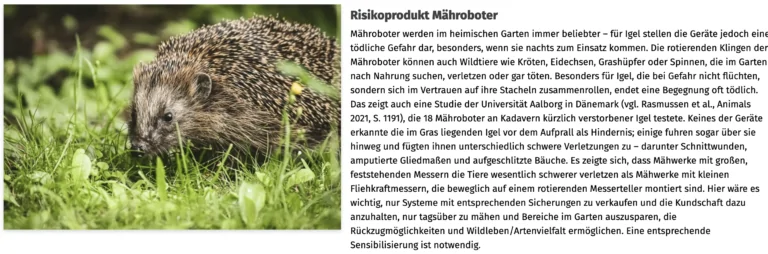
This preliminary work served to prioritize two product ranges: Ornamental plants and building materials. We have concentrated our further analysis on these. In addition, individual risk products were identified (see box for example robotic lawnmowers).
- There are established certifications and standards for ornamental plants, some of which cover biodiversity-relevant criteria. There is great potential here for DIY stores to design their purchasing guidelines accordingly. The phasing out of invasive species and, in particular, the expansion of native and regional plant ranges were identified as further fields of action. Long-term supplier relationships are also necessary in order to reduce the use of peat in plant production as well as potting soils. Good practices have already been identified here: For example, some DIY stores use residue monitoring for pesticides, employ insect experts to assess the range of plants or develop standards for peat substitutes such as HortiCert.
- In the area of building materials such as sand, gravel, concrete and gypsum, concepts for avoiding negative impacts and for the circular economy (cradle-to-cradle) were identified in order to save resources. Closed cycles help to reduce or completely avoid the extraction of natural raw materials. In the long term, they can also be more cost-effective than linear production models. Implementation is quite difficult for the individual company. Cross-industry cooperation and political framework conditions are required, e.g. in the area of closed material cycles.
Across all product ranges, there is a great need to train purchasing and quality management on biodiversity and ecosystems and to revise internal purchasing policies with regard to stricter biodiversity requirements. The focus should be on supporting suppliers.
Company premises
In 2023, a total of 2,067 DIY and home improvement stores were counted in Germany (cf. BHB, DIY sector figures 2023) Assuming an average sales and parking area of 10,000 m², this results in a considerable sealed area. Many DIY stores are located in industrial areas and close to nature reserves. In some cases, half of the locations are less than one kilometer away from the nearest protected area. Care must be taken here to ensure that the market in question does not have any negative effects, e.g. through light pollution. Investments can also be made in a protected area in cooperation with the local authorities.
Another risk for DIY locations in Germany is the availability of water. As the WWF Risk Filter Suite maps show, locations in eastern German states such as Brandenburg and Mecklenburg-Western Pomerania are particularly at risk of water scarcity. It is therefore worth investing in rainwater retention at an early stage – especially when it comes to watering the garden. Numerous biodiversity measures also help with climate adaptation in other areas: green and shaded roofs, walls and parking lots, for example, reduce temperatures and thus also energy costs in buildings.
 © Foto des Igels: Alexas_Fotos | Unsplash
Challenges and next steps
The GNF, the Lake Constance Foundation and the CSCP have carried out biodiversity checks not only for the DIY sector, but also for companies in other sectors. For the companies, the “formalized approach was very good and helpful in gaining new structured insights.” Particular emphasis was placed on the very extensive and permanent pool of knowledge created by the check, as well as the professional support in prioritizing topics and risk products.
However, a number of challenges became apparent during the implementation of the check:
- Expertise & mainstreaming in the company: Companies face the challenge of building up expertise and time resources for biodiversity. Expertise is required in ecological contexts as well as in legal requirements and corporate processes, and is complex. Another challenge is the involvement of relevant stakeholders in the company – including the management.
- Availability of data from the supply chain: The traceability of supply chains and the collection of biodiversity-relevant data are still in their infancy in many companies. Biodiversity is very complex to record and measure. Tools such as ENCORE and location analysis tools help you get started, as do supplier surveys and research. Companies should not only pay attention to reporting obligations here, but also consider how strategic data management can be established – also to continuously monitor their own performance!
- Industry solutions are needed! Many challenges – especially in the upstream and downstream supply chain – cannot be solved by individual companies alone. Particularly when it comes to circular economy strategies or ecological requirements for products, exchanges and joint approaches both within the sectors and with related sectors (e.g. in the area of building materials with the construction industry or in the ornamental plant range with DIY and food retailers) are very important.
Support services are already available and are expected to grow further. For example, the Federal Ministry for the Environment is funding the development and application of tools such as the Biodiversity Check as part of the “Unternehmen Biologische Vielfalt – UBi” project.
This article originally appeared in the March 2025 issue of econic, as well as on the website of the Unternehmen Biologische Vielfalt – UBi project.
